

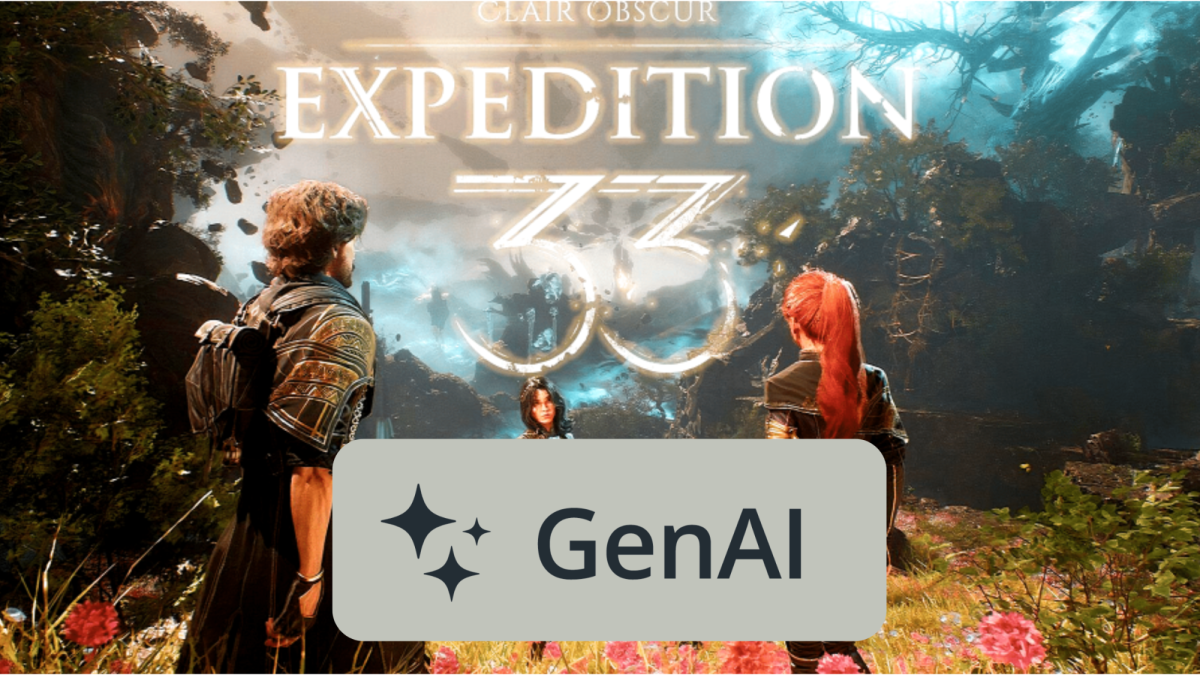
The end of 2025 has caused the video game industry to undergo a huge shift as artificial intelligence tools become more integrated into game development. The debate over the ethics of AI sparked controversy at this year’s Indie Game Awards including Clair Obscur: Expedition 33 being revoked of its Game of the Year Award.
Artificial intelligence, mostly generative AI, is being used across the industry for a range of tasks from concept art generation and procedural worldbuilding to automated voice work and code assistance. Both major, Triple-A studios and indie studios are experimenting with AI to accelerate production and reduce costs, a move proponents say can make game creation more accessible and empower smaller teams. Meanwhile, critics warn that without proper guidelines, AI could dilute creative authorship or marginalize human artists and developers.
“I just feel like AI doesn’t allow games to have that much emotion in it,” junior Ben Yzquierdo said. “Say if a game like Minecraft had AI in it, it wouldn’t be the same. Like if all the music was AI or something, then we wouldn’t have as nostalgic of a feeling towards it.”
Even huge studios like EA state that AI has been a long standing cornerstone of the company and that they are taking the next step into generative AI. The Electronic Arts site itself says that generative AI will expand creative possibilities and accelerate workflows.
This ongoing debate has taken center stage in the indie scene, triggering industry-wide discussion about where, if at all, AI should have a place in game production.
One of the most talked-about flashpoints in this debate has been the French indie role-playing game Clair Obscur: Expedition 33. Developed by Sandfall Interactive, the game was widely praised for its rich narrative and artistic design, earning several awards across different events. However, its reception was complicated at the 2025 Indie Game Awards.
Expedition 33 was initially named Game of the Year and Debut Game at the ceremony only to have both titles rescinded when organizers learned the studio had used generative AI tools during development according to Polygon. The Indie Game Award body said that the developers of Expedition 33 had agreed at submission that no AI was used; but later confirmation of AI-generated assets, including placeholder textures created early in production, violated the event’s strict rules. Even though most of those assets were patched out of the final release, the awards were retracted and reassigned to runner-ups Blue Prince and Sorry We’re Closed.
This incident has shone a spotlight on the lack of clear industry standards for AI usage: while some see the rules enforced by the Indie Game Awards as necessary to preserve craftsmanship in indie titles, others argue the decision was heavy-handed, especially given that the placeholder assets were removed and the game otherwise stood on its own quality.
“I personally don’t really think that it can still be qualified as an indie game at that point because, like you said, it’s not really just a small team working on it anymore,” junior Andrew Murray said. “It’s just AI, which anyone can really use and it gets rid of the most humanizing aspect of games.”
Expedition 33 has stirred passionate responses from developers and players. On one side, advocates for stronger AI boundaries in games praise the Indie Game Awards’ stance as a defense of human creativity. On the other hand, many see the ruling as symbolic of broader uncertainty over how to treat AI in creative industries mostly when tools are used responsibly or only in early stages of development.
Some publishers have taken an even firmer approach. Certain companies like Games Workshop, the makers of the Warhammer games, have publicly banned generative AI assets in projects they publish according to IGN. Many argue that the risk of unintended AI content slipping into final builds undermines quality and artistic integrity.
Meanwhile, Expedition 33 continues to enjoy commercial success elsewhere, including at The Game Awards where it secured many awards, a distinction entirely separate from the Indie Game Awards and unaffected by the AI dispute.
As AI tools become better and more widely used in game production, the industry faces crucial questions. How should developers disclose AI usage? What constitutes acceptable AI assistance versus unacceptable automation? And how should awards bodies, publishers, and the gaming community at large adapt to a landscape where human and machine contributions increasingly overlap?
“I think it’s going to be used more, but in a sense of use more ethically and not as often because customers aren’t going to buy games that are just made with AI,” junior Mark Ortoski said. “Nobody’s going to do that.”